
The only real answer to the question "What is contra dance?" comes when you try it. The next best thing is to see it being danced. Watch a few videos, then come back here and carry on reading!
Going contra dancing makes a great social evening because you don't have to learn any footwork (just walk smoothly to the beat) and because by the end of the evening you are likely to have danced with everyone else in the room.
You start by asking someone to dance or accepting an offer. One of you will dance the man's role, the other the lady's role; anyone can choose either role. You form long lines so that you are across from your partner. As the lines grow, the dancers take hands in groups of four from the top of the lines. In your group of four, you have another couple called neighbours; you arrange yourself so that, as you face these neighbours, the "man" is on the left, the "lady" on the right. The caller will then walk you through some simple moves during which you interact with your partner and your neighbours. One of the moves will move you up or down the line with your partner so that you get new neighbours. The music starts: "Turning, moving, spinning, dresses swirling, music beating, eyes in contact with a partner, then another, then another, then another, and the fiddle turns a corner, the phrase repeats, the dance repeats. You smile. Your body smiles." (Doug Plummer)
Allemande, dosido, gypsy, circle, star, ladies' chain, hey, swing - there aren't many moves to learn - this is a dance form from which you can get full pleasure the very first time that you do it.
Contra dancing has been evolving in America over the last fifty years, and still continues to evolve. The way the lines are set up and the way that the best dances (out of over 6000!) are choreographed means that everyone is moving all the time and that the moves flow beautifully into each other. On top of that the American styling adds extra spins, twirls and variations, so that you can interpret the music and do your own thing - as long as you are heading in the right direction as soon as the next phrase of the music starts!
In most dances you will get to swing your neighbour (a new one every time you move up or down the line!) as well as your partner. The swing is a wonderful experience. In its basic form you take your partner in your arms and spin together on the spot. Apart from the countless variations of how you can hold each other to achieve different effects and high speeds, there is a recent move towards treating the period of the swing as time that you can do anything you like with your partner. Using influences from swing, hip-hop, tango and dirty dancing, the dancers just get down to having fun on the dance floor.
The weekly Contrafusion dances will have an emphasis on teaching as well as dancing. If you have never done this type of dancing before we will help you to get started so that you can join in and have fun at your first dance.
We will also be teaching you how to do all the styling and variations that the Americans are now putting into their dancing, so, whether you are an experienced dancer or an up-and-coming beginner, we hope to help you enhance your dancing and add to your enjoyment of the dancing. We will also be happy to run workshops for any groups that want a taster of contra dancing.
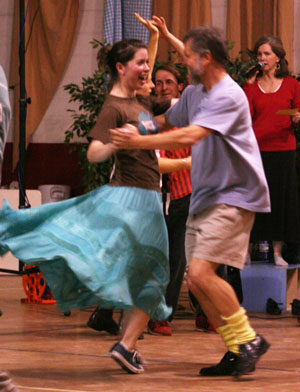
Contra Dancing in Greenville - Contra Dancing is fun!
Thanks to Sean Green for this great picture - more at flickr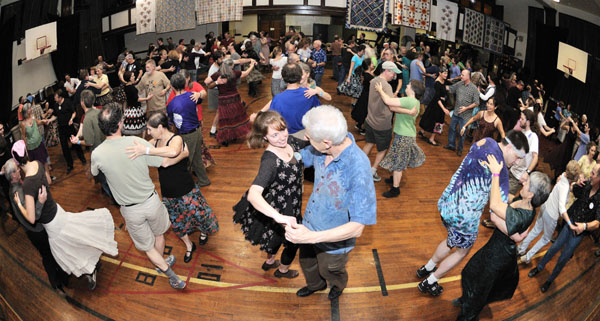
Rochester Thanksgiving Contra Dance Festival '08
Thanks to Jeff Folkins for this great picture - more at
folkins.net
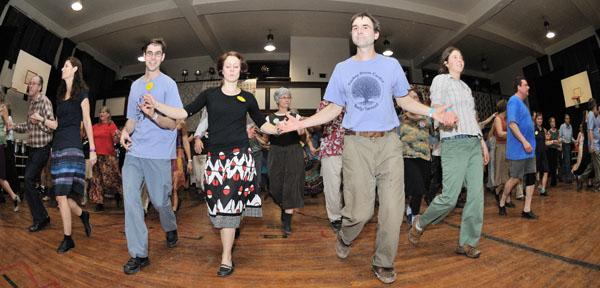
Rochester Thanksgiving Contra Dance Festival '08
Thanks to Jeff Folkins for this great picture - more at
folkins.net

Rochester Thanksgiving Contra Dance Festival '08
Thanks to Jeff Folkins for this great picture - more at
folkins.net
Swinging with your partner is a key part of modern choreography, especially in American contra dances, where most dances will have lots of swings with your partner, and with your neighbours all the way down the set. Meeting a dancer in the line who swings well is a real joy. There are countless different ways to swing, including walking swings, hornpipe swings and travelling swings, but the most popular by far is the simple buzz-step swing, done on the spot.
Two of the biggest challenges with swinging are:
I was always taught that rule number one is that everyone is entitled to have a good time on the dance floor without getting hurt. Sadly the way some people swing can leave their partner with aches and bruises. Cherish your partner and hold them as gently as you can! I’ve been dancing for 50 years now, but I still love learning new ways to improve my dancing. So here are some ideas that you might find useful.
The Buzz-Step Swing:Put some music on and start by standing by yourself and just walking on the spot (not turning), but with your right foot flat and your left leg slightly bent so that only the ball of the left foot is touching the floor, with the heel up in the air. The left foot should be trailing so that the left toe is roughly beside the right heel. It is just right-left-right-left - walking on the spot - no hopping or jumping. The objective of this type of swing is to rotate - any energy you use to go up and down is wasted! The motion is very like riding a scooter; in fact scooting up and down the hall with one foot trailing is good practice! Your feet should only barely leave the floor.
Now turn clockwise on the spot by yourself, making sure that your feet are close together and the left foot is trailing slightly. This is where the rotation comes from, from your feet, not from the angle or direction of your body! Your body should be perfectly upright to ensure that you maintain a good balance. Bend or softern your knees slightly so that you turn smoothly without going up and down.
For the next step you will need a partner. One person takes the traditional man's role and one person takes the lady's role. Once you both have the basics of turning on the spot smoothly, try taking the "ballroom" hold. Now, for a good swing you don't really want a formal ballroom hold; rigid or extended arms are uncomfortable. The most effective place for the man's right hand is high up, on the lady's left shoulder-blade, giving good support across a wide area, thus reducing the pressure on any particular point. (If you hold her lower than her shoulder-blade then centrifugal force will make her upper body move away so that she bends uncomfortably at the point where your hand is.) The lady's left hand just rests lightly on the man's arm. The man's left hand just holds the lady's right hand loosely. Practise turning smoothly together with your right feet close to each other, preferably with some steady music in the background. Your feet should be outside your partner's feet - it is your right little toes that are near each other.
Now, that is the start of a good swing.
Some people think that they will go faster if they lean back, but check your physics! It actually makes you go slower! All you do if you lean back is tire your partner out. Keep your own balance! Don't pull your partner towards you, just place your hands in good positions. As you speed up centrifugal force will try to pull you apart, but your good connection will keep you working as a single, gently counter-balanced unit.
To do high speed swings you need to form a single entity that is well-balanced and as symmetrical as possible. You also need to avoid dizziness. So a really key point is for both of you to turn your upper body so that it is facing your partner's, with your shoulders parallel. This also allows you to look into your partner's eyes; looking at your partner instead of the room stops you getting dizzy. If you aren't comfortable with eye contact then focus on somewhere slightly above or below your partner's eyes (but not too far below, gentlemen!) or on your partner's right shoulder.
The feet, of course, remain unchanged so that your bodies are twisted slightly at the waist. A good exercise for this, and a beautiful swing in its own right, is for the man to place both hands on his partner's shoulder-blades and for the lady to relax her arms completely - leave them in space, or rest them on the man's arms. Try swinging like this, and smile!
Control of body-weight is critical for a good swing. If you are too close together swings don't work well. Practise standing by yourself and taking your upper body back very slightly from the hips, without falling over. That is all you need to do to make the swing better - you don’t need to lean back - centrifugal force will take you both backwards slightly so that you get a good connection between the man's hands and the lady's shoulder-blades without making your partner support your weight.
Relax, look into each other's eyes and enjoy the swing.
Once you have that working well, go back to the ballroom hold - but without changing your relative body positions - keep your upper bodies facing each other! Foreshortening the hold between the man's left hand and the lady's right hand works really well - the man loosely cups the lady's elbow and the lady loosely cups the man's arm just above his elbow. Apart from saving space on a crowded dance-floor, it makes it easier to keep your bodies parallel to each other.
Hopefully, ladies, you will have had a good experience in the double-shoulder-blade hold and will now realise that you don’t need to grip, pull, press, clamp, dig in, hang off the man or anything else. If the man can get the lady to trust him, by being supportive and gentle (swings don't need strength!) then hopefully she will relax. Both partners must be responsible for their own balance.
To increase the speed of the swing make sure that you have a relaxed symmetrical coupling and then move your feet faster and further; keep them close to the ground - energy spent lifting your bodies up and down in the air is wasted - keep it smooth. The right foot steps forward further around the circle, reaching behind your partner's feet; the left foot just steps where it is.
A good swing should seem effortless - just cradle your partner and move your feet smoothly.
Now that you can swing beautifully, step two is to learn how to get smoothly in and out of the swing, timing it so that you are exactly on the musical phrasing, making the moves flow seamlessly from one into another, and giving your partner a great experience!
Practise! Enjoy your swinging and make your partner smile!
This article also appeared in the
Set & Turn Single Magazine.
Please contact John Sweeney if you can
help him improve this article.
Click here
to download this article on swinging as a PDF.
Goldilocks was enjoying her first dance until the caller said, "Allemande left your partner." Her partner gripped her hand tightly, pressing his thumb into the back of her hand, and pulled her arm towards his chest as though they were arm wrestling. Goldilocks didn't enjoy that at all and was glad when the dance ended. His connection was much too strong.
Her second partner was much gentler, but she was dismayed when, as they finished a Circle Left and prepared to Pass Through, he let go of her completely so that she went backwards instead of forwards. His connection was much too weak.
Then she found a wonderful man who helped her get round Stars and Circles, did great Allemandes and smiled as he swung her. His connection was just right!
Part of the definition of a Zesty Contra (Larry Jennings, 1983) is "Strongly connected: arms joined firmly but elastically, not only in allemande and swing, but also in circle, star, promenade, long lines, etc."
Why is connection so important?
Let's look at the changes in choreography first. Most old dances that have a Star or a Circle include a second one in the opposite direction. It doesn't matter how far you travel in the Circle Left as long as you travel the same distance back in the Circle Right. But modern choreographers use sequences such as Circle Left, Star Right. Both moves are in the same direction so you have to travel two full circles to get back to where you started.
Good connection helps you to make those complete circles. Connection in Circles, Lines and Gates comes from making a strong "W" with your neighbours, elbows down, hands up, connected by hooked fingertips (no thumbs!). If you stand in a circle of four with that connection and lean slightly to your side everyone else in the circle should feel it. Remember to go for an elastic feeling rather than rigidity. And avoid the "Nellie the Elephant Syndrome" where someone raises their leading hand but forces their trailing hand down low, forgetting that their trailing hand is someone else’s leading hand!
There are basically three ways to do a Star:
The Box Star is not a recent invention; Zesty Contras defines the New England style as having "well connected wrist-hold stars". Search for "Beautiful Contra Folk Dancing" on YouTube and you will see the dancers using it back in 1964.
I am told that in the Deep South the Box Star is not always used as the men's wrists get too sweaty and the ladies don’t like putting their hand on a sweaty, hairy wrist! But apart from that the Box Star is so easy and gives such great connection that it is not surprising that it is used so much in contra dancing.
Try a Circle Left, Star Right with hands low in the Circle and a bunch-of-bananas Star, then try it with "W"s in the Circle and a Box in the Star. When you connect to everyone else in your set and share the energy the dance moves much more smoothly and you get to where you need to be on time and with much less effort.
Coming back to the too much/too little discussion, let's look at the Allemande. Just put your palms at right angles (with your thumb beside your fingers - thumb grips can be uncomfortable and prevent spin outs), and gently hook your fingertips around the other person's hand. Next, how much tension? The key is to remember that you are not arm-wrestling; you are dancing! Go for equal and opposite tension, just enough to feel each other, but not enough to move the hands from mid-way between you. Make that nice "W" shape between you and connect with the eyes as well. As you speed up add just enough tension to keep the hands in the middle.
If your partner wants to spin out of the Allemande don't try to push them - it is more likely to throw them off balance than to help! Instead, if you feel them increasing the tension in preparation for the spin then just tense up a little yourself to give them a platform to spin off - it should be like two springs compressing and releasing - the hands never move from that mid-way position.
Finally, let’s look at that Circle Left and Pass Through that Goldilocks complained about, and look at making the dance flow smoothly. Try a Circle Left with a bit of speed then just let go. Which direction will you keep moving in? Backwards. Centrifugal force is pulling you away from the centre of the circle. Which direction do you want to go for the Pass Through? Forwards! Now try it with connection. Keep hold as you finish the Circle and line up for the Pass Through. Use the arms like springs; you extend slightly away from each other and then pull each other forward. That gentle elastic connection changes the direction of your momentum and makes the transition so much easier.
This principle applies to a very wide range of transitions: always stay connected to those beside you and use your connection to help each other into the next move. It is not your partner's job to drag you across the dance-floor; when you feel tension in your fingers, move your feet!
The best beginners' workshop I have ever seen focused on just three elements: counting up to eight, the Buzz-Step Swing and connection. Teach someone a move and it might help them get through certain dances. Teach them how to connect and you have set them on the path to becoming a great dancer.
Connection helps in all dances, but it is what makes many modern dances work. Practise your connection and enjoy that beautiful flowing choreography.
This article also appeared in the
Set & Turn Single Magazine.
Please contact John Sweeney if you can
help him improve this article.
Click here
to download this article on connection as a PDF.